About 50 per cent of the accounts that availed of the EMI moratorium amid the pandemic, which made things worse in an already slowing economy, are expected to be restructured, and of these accounts that would undergo restructuring, one-third, or Rs 6-9 trillion, could turn into NPAs.

One of the factors behind the rise in securitisation deals was State Bank of India's (SBI) decision to buy portfolio worth Rs 45,000 crore from NBFCs

While there was a sharp drop in footfalls in malls in H1FY21, there was reasonable recovery in H2. However, the second wave derailed the recovery.

At risk of entrenched rough times are sectors like hospitality and those with discretionary spends.

In twin blows to Indian economic revival, higher food prices drove retail inflation to a five-month high of 7.4 per cent while factory output fell for the first time in 18 months. The second consecutive month of rise in consumer price index (CPI)-based inflation will add to the pressure on the Reserve Bank of India (RBI) to again raise interest rates to tame high prices. Inflation has been above the targeted zone for the ninth month in a row and as per statute, the RBI will now have to explain to the government in writing why it failed to keep prices below 6 per cent.

Hawkish tone likely to guard rupee from further slide
In November, the fiscal deficit widened by Rs 2.2 trillion, the highest ever in any month this financial year.

However, it may still not change its stance on the policy rate as inflationary pressures are coming from high commodity prices.

The wholesale price-based inflation spiked to 12.54 per cent in October, mainly due to rise in prices of manufactured products and crude petroleum. WPI inflation has remained in double digit for the seventh consecutive month beginning April. Inflation in September this year was at 10.66 per cent, while in October 2020 it was at 1.31 per cent.

Retail inflation fell to a five-month low of 4.35 per cent in September from 7.27 per cent in the year-ago period as prices of vegetables and other items declined, according to government data released on Tuesday. The moderation in Consumer Price Index-based inflation is in line with the assessment of Reserve Bank Governor Shaktikanta Das who recently projected substantial softening of retail inflation. The CPI inflation was at 5.3 per cent in August and at 7.27 per cent in September 2020.

Tyre companies are stepping up on exports to offset declining volumes from domestic OEMs.

Retail inflation hit an eight-month high of 6.07 per cent in February, remaining above the RBI's comfort level for the second month in a row, while wholesale price-based inflation soared to 13.11 per cent on account of hardening of crude oil and non-food item prices, government data showed on Monday. The previous high for retail inflation was 6.26 per cent in June 2021. The consumer price index (CPI) based retail inflation, which is taken into account by the Reserve Bank of India (RBI) while deciding its monetary policy, rose mainly because of costlier food items, as per the data released by the National Statistical Office (NSO).

The muted CPI inflation print at 5% earlier this week, followed by a similar WPI number released Wednesday, seems to have spurred India's central bank into action, is how the economists are reading into Reserve Bank of India governor Raghuram Rajan's 25 basis point cut in repo rate.

With the stock coming under pressure, the MF holding value could have dropped to Rs 50 billion, back-of-the-envelope calculations show.

Punjab National Bank on Monday allayed concerns about its exposure to Adani companies and noted that its loans to the group are diversified into 8-9 companies, which are generating sufficient cash. Atul Kumar Goel, the bank's MD & CEO, in a post-earnings call said total exposure to Adani group, so far, stands at Rs 7,000 crore, of which Rs 2,500 crore is in the airport sector. He further said there is "no worry as the exposure is not very big" and that the bank is keeping an eye on the development that is taking place.

Since January 2021, the inflation rate in health has stood in the range of 6.08-8.44 per cent.

After a record run in FY2022, when the brokerage industry is set to report over 30 per cent topline growth at around Rs 28,000 crore, the industry is set for a tepid growth next fiscal even though the outlook is stable, says a rating agency report. The market has been on a song since June 2020 when the first wave of the pandemic ebbed and since then it has had record run with the stock indices more than doubling since the Covid-19 mayhem in March 2020 and scaled new life-time highs since then. The market frenzy was also visible in the massive number of new investors coming to the equity market, as exemplified in the more than trebling of the demat accounts since April 2020.

Retail investors have put at least Rs 2,296 crore in listed companies facing proceedings under the Insolvency and Bankruptcy Code (IBC). A median such-company had 16,163 retail investors as shareholders many of whom apparently have bought a stake on the hope of making money if the firm revives. They own a fifth of the total stake in the companies under consideration. The analysis looked at 75 listed firms for whom shareholding data was available for March 2022.

Yes Securities, the broking and investment arm of Yes Bank, on Wednesday said the Supreme Court directive on loan moratorium due to pandemic has brought the much needed clarity and there will not be any financial impact on the banks as the compound interest waiver is to be reimbursed by the government. On its verdict on a batch of pleas seeking moratorium extension beyond August 31, 2020, the apex court on Tuesday said it is a policy decision, refusing to interfere with the Centre's and RBI's decision to not extend the loan moratorium beyond the limit. However, it observed that the benefit of moratorium should go to all set of borrowers irrespective of the loan amount and asked to refund any amount collected as penal interest and compound interest during March-August 2020.

The wholesale price-based inflation in February rose to 13.11 per cent on hardening of prices of crude oil and non-food items, even though food articles softened. After two months of mild easing, WPI inflation accelerated in February and remained in double digits for the 11th consecutive month, beginning April 2021. WPI inflation last month was 12.96 per cent, while in February last year, it was 4.83 per cent. The rise in crude oil and natural gas prices after the Russian invasion of Ukraine, beginning February 24, has put pressure on the wholesale price index, even though food articles saw softening across categories of vegetables to pulses to protein-rich items.
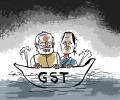
In the current financial year, the Centre released nearly Rs 1 lakh crore compensation to the states till September.

For the first time in 21 years, the Reserve Bank of India (RBI) will revise norms for investment portfolios of commercial banks to reflect changes in global standards on valuation and measurement, and progress in the domestic market. This could pave the way for banks to transition to the new accounting standards (Ind-AS). The outstanding investment portfolio of commercial banks was at Rs 45.84 trillion as of November 19 this year.

According to Icra, domestic passenger traffic declined by 1.1 per cent in March, overall traffic saw a de-growth of 0.1 per cent in the month as international aircraft movement dipped by 1 per cent while domestic aircraft movement was flat.

A looming global shortage of diesel in Europe presents India with more than one opportunity to profit from strong margins. A shortage of the fuel, a key contributor to inflation, has been exacerbated by the conflict in Ukraine, and western sanctions on Russian fuel supplies. The slowdown in natural gas supply means the West needs diesel to heat their homes this winter.

Leading automakers Maruti Suzuki India, Hyundai and Tata Motors reported a double-digit increase in dispatches to dealers in April as the demand remained robust especially for the sports utility vehicles. The country's largest car maker Maruti Suzuki India (MSI) said its domestic passenger vehicle wholesales rose 13 per cent to 137,320 units last month as against 121,995 units in April 2022. Sales of mini cars, comprising Alto and S-Presso, fell 18 per cent to 14,110 units as compared with 17,137 units a year ago.

According to the Icra report, earnings before interest, tax, depreciation and amortisation margin of its sample declined by 44 basis points on a YoY basis and 23 basis points on a quarter-on-quarter basis to 16.6 per cent.


India always faces a Hobson's choice as far as feeding coal-fired generators goes - even if the government is reluctant to admit it. The country cannot do without shipping in the world's most polluting fuel from overseas. And it will continue to do so unless it decides to reduce demand by forcing citizens, farmers and businesses to live without electricity for part of the day, or use diesel generators to fire facilities.

The financials of six privately held companies associated with Siddhartha show an increase in debt and falling ability to meet short-term obligations.

Fitch Ratings has cut India's economic growth forecast to 8.7 per cent for the current fiscal but raised GDP growth projection for FY23 to 10 per cent, saying the second COVID-19 wave delayed rather than derail the economic recovery. In its APAC Sovereign Credit Overview, Fitch Ratings said India's 'BBB-/Negative' sovereign rating "balances a still-strong medium-term growth outlook and external resilience from solid foreign- reserve buffers, against high public debt, a weak financial sector and some lagging structural factors". The 'Negative' outlook, it said, reflects uncertainty over the debt trajectory following the sharp deterioration in India's public finances due to the pandemic shock.

Like everything else, the structure of banks may change, and banks may depend more on digital technologies and artificial intelligence for dealing with both their customers and employees.

The output of eight core infrastructure sectors grew marginally by 0.1 per cent in January, mainly due to growth in the production of fertiliser, steel and electricity. The core sectors had expanded by 2.2 per cent in January 2020, according to the provisional data released by the commerce and industry ministry on Friday. Coal, crude oil, natural gas, refinery products, and cement recorded negative growth in January.

New Delhi's timing couldn't have been worse, both for India's fledgling electric vehicle (EV) sector and prospective electric bike buyers. It was hard to miss the perfect storm brewing for India's EV industry since early 2022. On one hand, you had several accidents involving battery fires that unnerved consumers; on the other, uncertainty had crept in over subsidies.

The output of eight core sectors jumped by 56.1 per cent in April mainly due to a low base effect and uptick in production of natural gas, refinery products, steel, cement and electricity, official data released on Monday showed. The eight infrastructure sectors of coal, crude oil, natural gas, refinery products, fertilisers, steel, cement and electricity had contracted by 37.9 per cent in April 2020 due to lockdown restrictions imposed to control the spread of coronavirus infection. In March this year, the eight sectors had recorded a growth rate of 11.4 per cent.

The production of eight infrastructure sectors rose by 7.5 per cent in October on healthy performance by the segments of coal, natural gas, refinery products and cement, official data released on Tuesday showed. The output of eight core sectors of coal, crude oil, natural gas, refinery products, fertilisers, steel, cement and electricity had contracted by 0.5 per cent in October 2020, according to the data released by the commerce and industry ministry. Core sectors' growth stood at 4.5 per cent in September this year.

Growth has been under pressure since the lockdowns related to Covid-19 started and fresh prescription generations slowed.

Infra segment, refinery product impacted the most, even as contraction narrows in latest month.

UPA-II has yielded a 7.5 per cent average annual growth rate

While margins contracted by 30 basis points on y-o-y basis, they fell a sharper 120 basis points on a sequential basis to 16.8 per cent. Profitability was impacted adversely due to subdued demand, tepid realisations in commodity sectors, and negative operating leverage.

Analysts at rating agency ICRA say the debt level of the telecom companies is very high and the ecosystem for the premium band is not in place.
